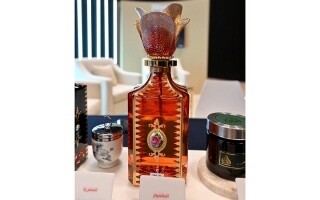
Researcher Latifa Dawood Al Neaimi, inspired by traditional poetic verses, has created a collection of perfumes linked to memory and local sentiment. These scents have been used by the people of the UAE for many years. She presented them through the initiative 'Abir Al Qasid', launched by the Abu Dhabi Authority for Culture & Heritage, to document heritage. Latifa Al Neaimi, a Documentation Specialist at the Poetry Academy, told 'Emirates Today' that the initiative highlights the connection between poetry and perfumes. It is based on her extensive research, which will be published in a book titled 'Ornamentation and Clothing in the State of the UAE'. The book covers perfumes traditionally used by the people of the UAE. A QR code has been added to each perfume, which, when scanned, displays poetic verses related to it and information about the poet. The initiative was launched concurrently with the Abu Dhabi Poetry Festival, held in the capital over three days, with the aim of documenting local perfumes to prevent them from fading away. This is especially important as some perfumes and materials used in adornment have seen a decline in interest and are no longer in demand as they once were. She added that Nabati poets were deeply connected to the UAE's environment, which was reflected in their poetry and their use of various terms. Topics they included were types of perfumes famous in the region, such as musk, jasmine, rose, saffron, amber, sandalwood, and agarwood (oud), as well as 'mashmoom' and 'fal', perfumes that are no longer commonly used. They also included other cosmetic materials and perfumes like 'mahlab', 'al-baddaha', and 'zibad', which are materials used exclusively by women. On the selection and blending stage, Latifa Al Neaimi revealed that the work on implementing the initiative took about three months. During this time, she selected the perfumes and tasked women with creating them, as well as determining the poetic verses associated with them. She noted that the perfumes were made by the hands of Emirati women and took some time because some of them are no longer common. She continued: 'Among the perfumes and preparations that are no longer used is 'al-baddaha', a type of aromatic oils and herbs that are ground and mixed together and used in 'aghas' (hair styling or braiding). It is distinguished by the fact that each household created its own mixture to give it a special scent different from others. Another female perfume is 'mashmoom', which is fermented in the ground in a warm environment for three months. It contains various components, the most prominent of which is saffron. These mixtures are often considered by the woman who makes them a secret that she must preserve and does not reveal the ingredients of to remain unique.' The researcher noted that general taste in perfumes has changed over time, with a decline in the popularity of some traditional types and a shift towards internationally recognized floral scents. However, she confirmed that there is currently a strong return to traditional perfumes, especially with the emergence of local brands that offer them in an elegant style that blends authenticity with modernity. The return to traditional perfumes has become a trend at weddings and events, especially 'mashmoom', which is a positive thing because preserving the lexicon related to heritage preserves the society's identity and collective memory and transfers it to new generations, increasing their connection to it. Among the verses that the 'Abir Al Qasid' initiative recalls about 'mashmoom' is a poem by the late Sheikh Zayed bin Sultan Al Nahyan, God rest his soul, in which he says:
'A welcome to the east wind, its scent is narcissus and mashmoom. I welcome it and it has raised my spirits and all my worries have vanished.'
Also, two other verses about 'oud' by the poet Salem Al-Jumairi, in which he says:
'A welcome to the source of generosity, its sources are like bamboo. Its embraces soothe every sorrow, about oud, amber, and saffron.'
Latifa Al Neaimi: 'The perfumes were made by the hands of Emirati women, and it took some time because some types were no longer common.. We are witnessing a strong return to traditional perfumes, especially with the emergence of local brands that blend authenticity with modernity.. 3 months, the preparation period for the initiative.'